 I have had the benefit recently of learning about the stories of Richard, Charlie, and Dierdre Croft though the documentaries focusing on Richard and from Dierdre’s own writing.
The documentaries teach so much about experiencing the support and love of a person with a severe ID ini Australia across 4 decades. The first, Driving with Richard, introduces the family and contains scenes of the trauma when someone is hitting, hair pulling, but also loving – I think this is a must watch for anybody supporting people with challenging behaviours – it can only feed an empathy.
The second, Wonderboy, shows Richard growing out of schooling and his life with his father. It unpicks the complexity of choice in the context of different people and different abilities. It has particularly got me thinking about the place of strong voice in the support of people – when do people need strong boundaries, who can deliver strong boundaries?
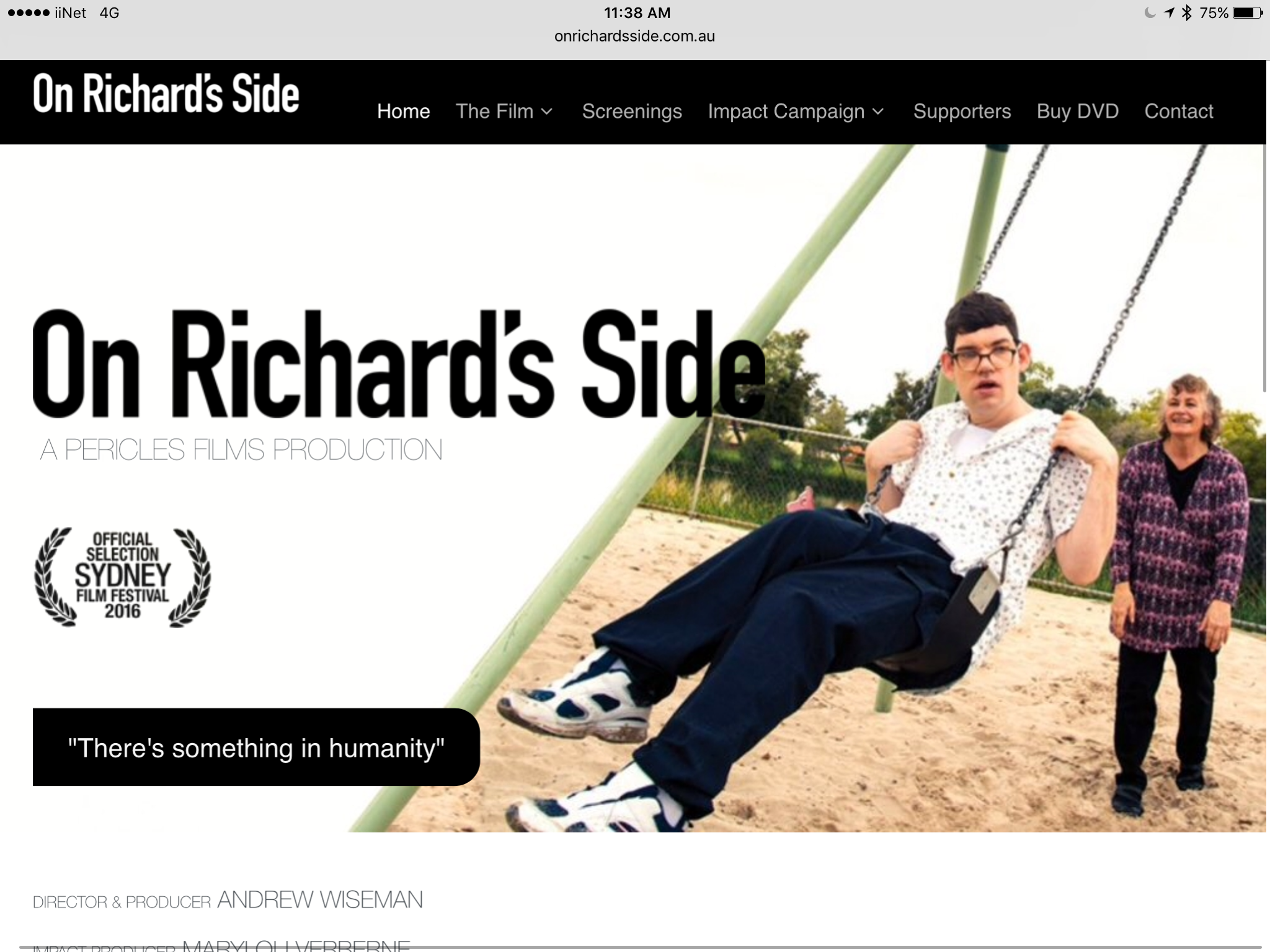
The third film, On Richard’s Side hasn’t been released yet. It had a screening at the Sydney film festival, and will have a number of community screenings upcoming (I’m hoping to host one in my neck of the woods). The trailer shows that it will be yet another piece of essential viewing. http://www.onrichardsside.com.au
I also came accross Dierdre’s submission to the Review of the National Disability Advocacy Program – https://engage.dss.gov.au/ndap_consultation-submissions/deirdre-croft/. Here is a snippet of her submission, which I think may be relevant to readers of my blog:
AN ADVOCACY QUESTION
Who is qualified to speak for those who cannot speak for themselves?
In making this submission, I begin with a question in my own mind, which I hope your own committee may also pose, as well as answer, in the current review of the National Disability Advocacy Program.
My question is:
Who is best qualified to represent and advocate for my son’s lifelong needs for support with personal care, skills development, physical activity, recreational opportunities, social engagement and other quality of life dimensions?
As an extension of that question, I also ask:
Who is best qualified to represent and advocate for the systemic issues and obstacles facing people, like my son, who have a severe intellectual disability and complex needs and who are, in many cases, unable to speak or advocate for themselves?
DOES LIVED EXPERIENCE OF DISABILITY QUALIFY A PERSON
TO ADVOCATE FOR MY SON?
As well as a severe intellectual disability, Richard is sight impaired.
Would a person who has lived experience of being blind or vision impaired be sufficient to inform any advocacy they may undertake that is relevant to the lifelong needs of my son and of others like him? I think not.
Although Richard can walk, he also has mobility challenges and needs support to navigate the physical environment.
I wonder whether a person who is also restricted in their mobility, but otherwise intellectually competent, could understand and advocate for the needs of someone like my son, and other people with intellectual disability who similarly experience mobility restrictions. Again I think not.
Richard has no verbal communication. Perhaps a person with hearing impairment might understand what it may be like for someone like Richard who also faces communication challenges? No again.
DIFFERING DIS/ABILITIES DIFFERING NEEDS
From the range of disabilities listed above and, as an intellectually competent person, I can quite easily imagine what it might be like to be blind, or to be deaf or to have mobility restrictions. I could even use a few props to enhance my understanding.
I cannot, on the other hand, imagine what it is like to live with a severe intellectual disability as Richard has, nor do I understand how my son perceives his world.
It is only because I have a close and long term personal relationship with my son that I am able to pick up on the subtle changes in his state of equilibrium and sometimes, not so subtle, changes in his behaviour which enable me to discern how he is travelling and/or what may be disturbing or disrupting his quality of life.
For people with physical or sensory disability, I believe I also understand some of the access and inclusion issues they might face in their quest to participate and be included in all dimensions of Australian society.
I would, however, suggest that the physical and social barriers faced by people with physical or sensory disability can, in large part, be readily rectified with some accommodations in the physical environment and/or by championing changes in discriminatory public attitudes.
In a hierarchy of human needs, the “access and inclusion” and “choice and control” issues advocated by, often highly intelligent, articulate people with physical and sensory disability are nowhere near the priority issues impacting on my own son’s wellbeing and quality of life.
My son’s disability is pervasive. It impacts on every dimension of his life.
He depends on every person who comes into his life to do the right thing by him.
Richard relies on other caring people to:
• meet his most basic physical needs
• provide opportunities and support for him to engage with his physical and social environment
• provide opportunities and support for him to develop and practice skills that will enable him to maintain and increase his competence and personal independence
• speak up for him and advocate on his behalf.
The extent and breadth of my son’s multiple disabilities not only makes him incredibly dependent on the good intentions and actions of others, but also incredibly vulnerable if these good intentions and actions are not forthcoming (even in one single person who may be involved in his day-to-day life).
How could a person with a singular physical or sensory disability possibly understand what life is like for Richard, and for others like him. How does their lived experience of disability help to inform any advocacy they might undertake for the hundreds of thousands of people like Richard in our society?
And yet people with physical and sensory disability with a lived experience of their own particular disability are predominantly those who populate the current, generic disability advisory and advocacy groups.
Regrettably, there also appear to be many people with physical and sensory disability amongst this same population who deny the legitimacy of the advocacy contribution of family carers who seek to represent and advocate, not only for the needs of their own family member with severe intellectual disability, but for the needs of others like them, who, like Richard, cannot speak for themselves.