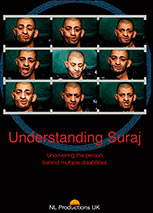
Understanding Suraj – An invaluable resource for anyone supporting someone with profound intellectual and multiple disabilities (and others)

DVD cover Understanding Suraj
DVD cover

That person that I’m working with, I’ve got as much to learn from them as they have from anybody else around them. And I want to be open to that. And I don’t want their life to be a wasted life; that’s the other thing isn’t it. Somebody whose maybe going to live for 40 years and then die, and nobody managed to unlock that potential and nobody managed to get in there because that is just a wasted life. I don’t want that to happen, don’t have to have wasted lives do they. They’re human beings with just as much potential as anybody else, and that’s unlocking, let’s find out what’s in there. Let’s not let it be wasted; let’s learn from that person.  – Rebecca Leighton in Understand Suraj DVD.

I was so excited to receive my copy of Understanding Suraj: Uncovering the person behind multiple disabilities from NL Productions UK, and I wasn’t let down.

This is a 45 minute DVD presented in four parts, including a background of Suraj narrated by his father, an observation of Suraj, and unpacking the current approach to being with Suraj. The story is honest, showing the disturbing self-injurious behaviour that Suraj had used for years, and using the voices of support workers and therapists to talk how they now approached Suraj.

Some viewers may struggle with the various strong English accents of narrators in Understanding Suraj. While the DVD appears  to begin with subtitles, these don’t appear to continue (as far as I could see). While I’ve spent time with Graham Firth, one of the narrators, I did need to spend some time re-getting my ears around his northern accent. Similarly, just getting the quote above took me several minutes of re-listening to capture some of the phrases.

While the narrators discuss Intensive Interaction (Nind & Hewett www.intensiveinteraction.co.uk) as a framework underlying the communication approach with Suraj, it is not essential that you have background knowledge of the approach to follow the story. Following viewing the film, viewers may want to learn more about Intensive Interaction.

I recommend this DVD to anyone supporting people with profound intellectual and multiple disabilities, and particularly for those who may use self-injurious behaviours. I think this would be a great DVD for teams to watch and discuss. Some of the practices they see on the DVD may be the same as what they are already do, and some may be markedly different. It would be useful for teams to discuss whether they would consider using the methods with people they support, and unpack why they may or may not do things and the subsequent potential implications of these choices for them and the people they serve.

Speech pathologists and occupational therapists may also find Understanding Suraj an invaluable resource. It may challenge current practice or support ways of working. The DVD shows that dynamic interactions must be the centre communication supports (communication supports must go beyond personal communication dictionairies, chat books and object of reference).

I also think that this would be an excellent resource for staff at the NDIA – it gives such a rich picture of one individual, the experience of families and support workers, and the possibility of an improved life through working towards the best possible relationships between staff and the person they serve. These relationships need to be thought about, planned, informed and supported. Sometimes they occur naturally with amazing support workers. But too often, in line with Rebecca Leighton’s words (specialist speech and language therapist), the time is not given to unlock and spend the time to get to know the person in their full potential.

The DVD can be ordered through DL Productions UK – http://www.nlproductionsuk.co.uk/styled/DVD%20Understanding%20Suraj/. It is also available through Amazon UK, but this does not appear to be able to be shipped to Australia at the moment. A short intro the the video is also available on YouTube – http://youtu.be/inWvCsumQLk


Do adult services for people with severe or profound ID need a guide like this for social-emotional supports?

  
Does adult services need something like this document from Childcare services that makes explicit the needs and requirements of staff? https://www.kidsmatter.edu.au/sites/default/files/public/KM%20Linking%20resources%20C2%20Book_web_final.pdf

Is having someone to talk to the biggest problem?

Lately I’ve been think about what I’m starting to think is the biggest communication problem in day and residential services for people with severe and profound levels of intellectual disability: the lack of having someone to talk/interact/share attention to/with.

I visit many places doing Brief Interaction Assessments. Through spending time with the person, I am able to come up with small achievable goals (that I’ve tried out with the person). I come up with other ideas for how to enhance interaction with the person and work towards greater shared understand. Sometimes I might suggest technology or different sorts of communication systems. But mainly it is all about ways to interact with the person, and how to help the person be calm and alert for optimum interaction.

But I feel like the foremost problem is cultures that have devalued the importance of sitting down with a person for a few minutes, without doing anything to the person (not giving the person medicine, or assisting with their meal, or stopping behaviours perceived to be inappropriate), just watching, attending, responding, and sharing with the person regularly.

When I visit services in the afternoon, I am often told that the person “is resting after their day at their day service”. Sometimes I’m told “they just like their own space” (and sadly I see this written in reports – a comment that I believe only perpetuates the lack of interaction and fails to explore under what conditions the person does tolerate or enjoy time with others). Sometimes I’m told “we interact after dinner, after so and so has gone to bed”. And sometimes I’m told “we just don’t have the time”. I would love to trust and respect those comments, but when I hear them over and over, and I rarely see a staff member just sitting down engaging with someone, then I feel despondent.

One of the ways that I’ve tried to change this culture is by introducing the HOP (Hanging Out Program) – a commitment to giving a person 10 minutes of interaction. But this is not enough.

I feel that a different approach is needed: something that says “if you haven’t sat down and interacted with at least one of your residents/service users, then you haven’t done your job”. Something that says the three hours of self-engaged sucking on your clothes in the same position is NOT having a rest after day-service, it is being shut out of the world.

Does sitting down with a person need to be on the task list of the day? Does it need to be included in service audits? Do policies need to explicitly say “the interaction between the support worker and person with a disability is at the core of the person’s quality of life”? Do we need to challenge the idea that sitting down with a person is slacking off, is just mucking around?

Do we need to say that the core of communication is spending time with another person, which can be a support worker, and, without that time, the success of any other interventions will be severely limited? You could have the amazing eye-gaze communication device or iPad with great communication apps, you could have a “sensory program”which picks up your smallest movements and transfers them to beautiful sounds, or the simple ability to reject or accept something, BUT without someone sitting down with you there is no communication.

How do we make this change – is this change needed – what do you think?

DVD cover Understanding Suraj
DVD cover

I was excited to see this snippet today called Understanding Suraj (read about it in the most recent UK Intensive Interaction Newsletter). I will definitely by buying the whole DVD. What do you think of it, how did it make you feel?